
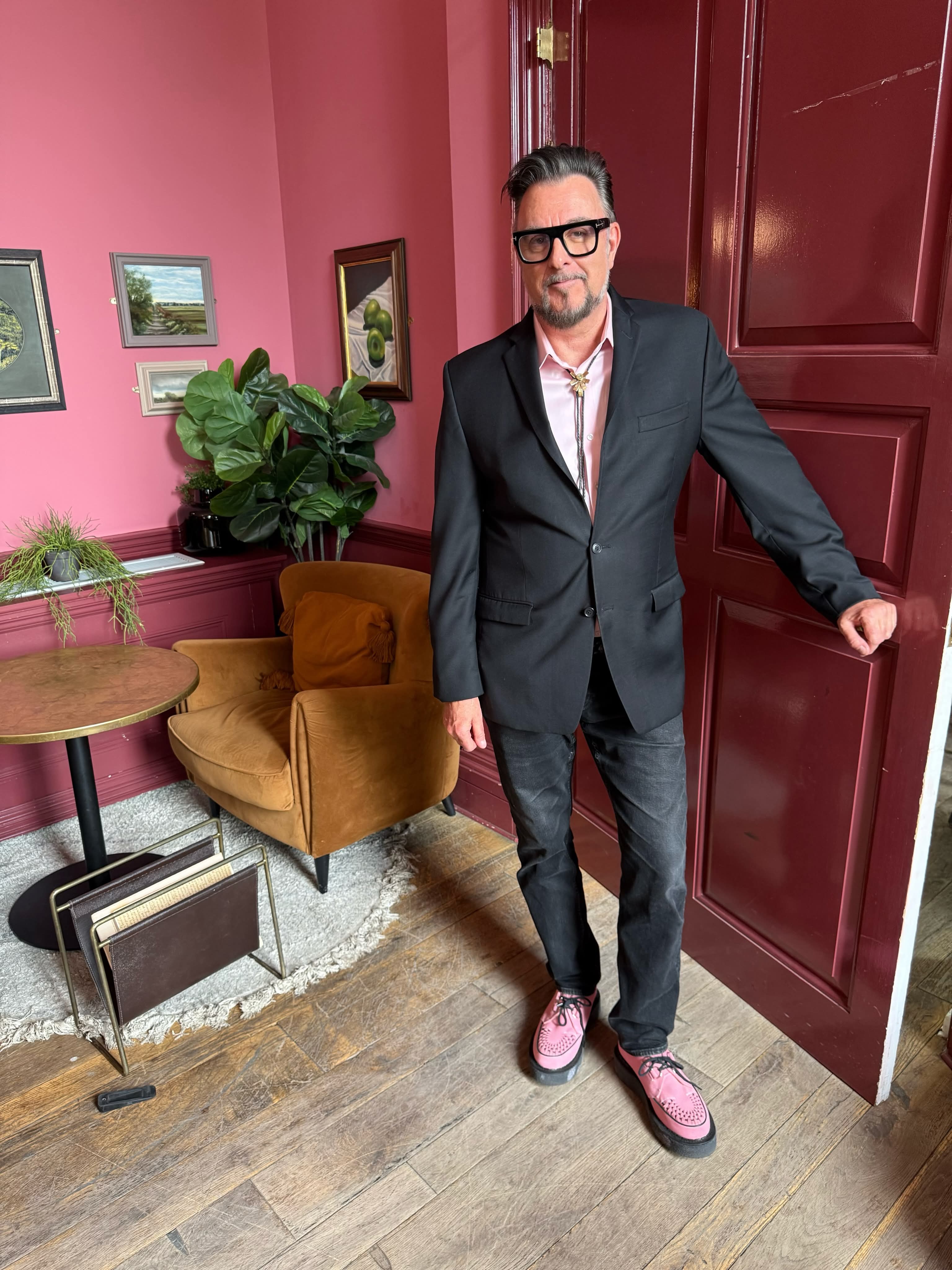
It is sometimes underrated how much does a producer and/or an engineer contribute to add value to successful records reaching global success. The three decades between the 80's and the 00's, especially, would have not been the same without the vital work of producers and engineers like Rick Rubin, Trevor Horn, Daniel Lanois, Mutt Lange, Flood, Bob Clearmountain and the list could go on and on.
Among this illustrious list of producers and engineers that have done so much invaluable ground work for the music industry, sits very deservedly the British record producer and engineer Tim Palmer. In a four-decades plus of career span, Palmer has worked and still does with the cream of the music industry, with an all-star list of artists he has worked with so far which includes Pearl Jam, Robert Plant, U2, Tin Machine, Tears For Fears, Ozzy Osbourne, The Psychedelic Furs, House Of Love, Porcupine Tree, Goo Goo Dolls, The Cure and many more.
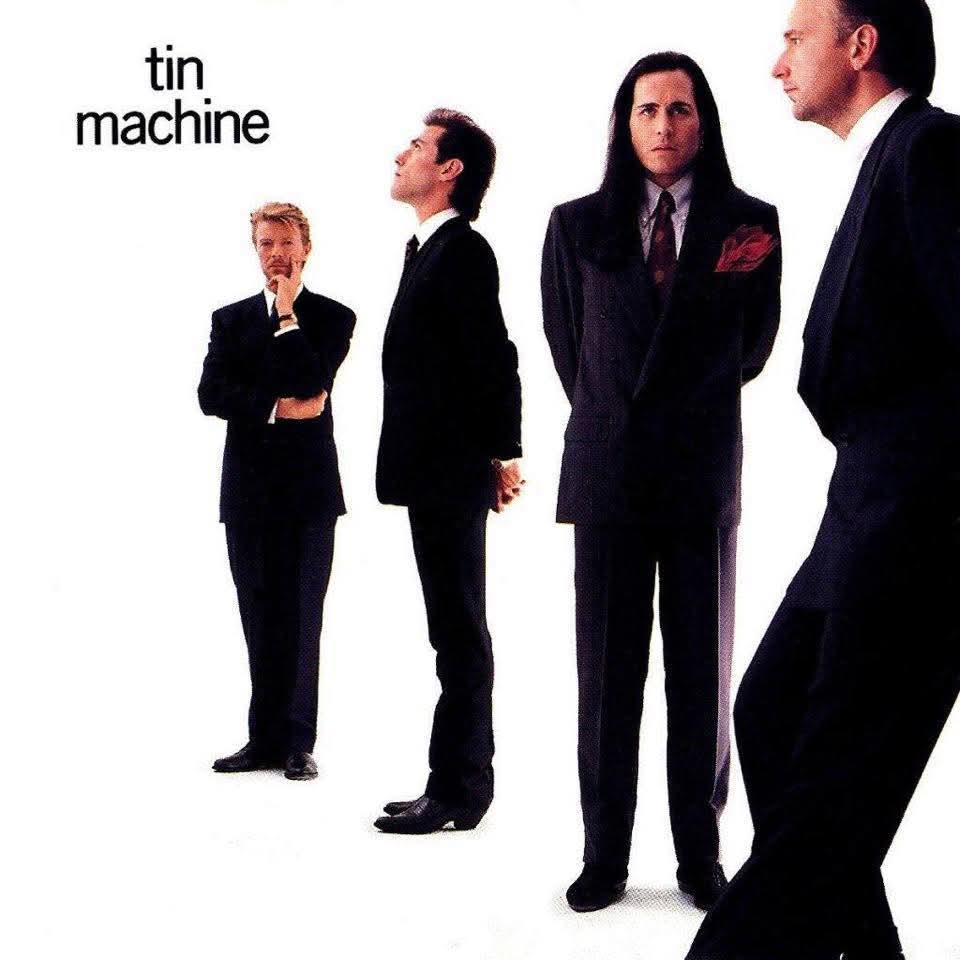
Tim Palmer has very graciously accepted our website's invite to take us through his time with Tin Machine's sole two studio albums in the late 80's and early 90's, which he worked on, with a band like Tin Machine that included in its line-up David Bowie (vocals), Reeves Gabrels (guitars), Tony Sales (bass) and Hunt Sales (drums).
The British producer, who has been living for many years now in the United States, takes us to the making of Tin Machine and Tin Machine II, touching also, later in the interview, on his long time collaboration with Tears For Fears, revealing particularly his own experience of working on the record that saw the reunion of Tears For Fears' original line-up, the 2004 album Everybody Loves A Happy Ending.
BR - Tim, thank you so much for talking to us at Bluebird Reviews. Going back to the beginning of your time with Tin machine, you’ve often mentioned, in other interviews, that you were already a big fan of David Bowie’s work, before you ever met him. When you received that famous phone call from David and his team, did you immediately expect you’d be working with Bowie on a single or even a full album with him? And were you surprised to discover that it wasn’t a David Bowie solo project at all, but something more like a band‑based album?
TP - It’s funny, back in the ’80s I used to joke with my engineer, “I’m taking the weekend off… unless David Bowie calls.” That was my line. And then one day, he actually did! At the time, I was working with a lot of guitar bands — House of Love, The Mighty Lemon Drops, The Mission, Texas — that whole scene. David had apparently been looking for an engineer/co‑producer, and he’d reached out to Billy Duffy from The Cult. I hadn’t worked with Billy directly, but The Mission and The Cult were close, so we knew each other. Billy very kindly put my name forward, and I’ve thanked him for that. My manager called first, saying, “You’ll be getting a call in the next 20 minutes,” , which definitely put me on edge. There had been no mention of Tin Machine at that point, that idea didn’t really emerge until we got to Nassau. I assumed the call was simply to talk about the possibility of working with David and hear what he was up to. When he rang, I’ll be honest, it was nerve‑wracking. I was speaking to one of my childhood heroes. He told me he’d been working with a guitarist named Reeves Gabrels — who I didn’t know at the time — and that they were developing demo ideas in his studio in Switzerland. He asked me about which Bowie albums I liked, what he'd been doing, that sort of thing. Then he asked what my favourite Bowie album was, and I said Lodger. He told me that was “very appropriate,” which stuck with me. It was a very general conversation, and of course, David Bowie is not someone you say, “Can I hear some demos before I agree?” to — especially when you’re 26. So, I just said, “Yes, I’d love the opportunity to come to Switzerland,” and he gave me a date. That was it. I put the phone down, and it was a pretty special day.
BR - At what point did you realise that the project you were joining was going to be a departure from Bowie’s trademark sound, something more rock‑oriented, as you later discovered while working with him?
TP - Honestly, I sensed it right from that first phone call. The way David described what he and Reeves were creating made it clear this wasn’t going to be a typical Bowie record. And once we actually started working together, it became obvious why. He was pretty disappointed with where he’d landed musically at that stage of his life. After constantly reinventing himself over the years, he felt he’d reached a point where he was making music for other people, which was completely alien to him. He’d shed his skin so many times that doing it again wasn’t difficult. In some of the quotes I read, he said that Tin Machine was his midlife crisis, and in a way, it was. It gave him a chance to reset, redefine how he wanted to create, and, most importantly, to have fun again. There had been a lot of pressure from EMI and the two albums before Tin Machine, Tonight and Never Let Me Down, were classic examples of ’80s pop production: gated reverbs, heavy programming, lots of synths. I think he found all of that a bit cold and clinical. What David always did best was bring humanity into his music, and he felt he’d drifted away from that. Around that time, he was listening to Sonic Youth, the Pixies, Glenn Branca, all this raw, noisy, experimental stuff. He wanted a fresh start, something that felt alive again. And that’s really what he was aiming for with Tin Machine.
BR - When you first met Bowie, we assume you were introduced to Reeves Gabrels, and later on to the Sales brothers as well. Did you have any background knowledge about Tony and Hunt Sales as musicians, or did you only know them from their work on Iggy Pop’s Lust for Life?
TP - No, not at all. As you said, when I arrived in Switzerland there were two things that struck me immediately. First, I had this grand idea in my head of what Mountain Studios would be, a modern, glass‑fronted control room with views of the Alps and skiers going past. I couldn’t have been more wrong. Mountain Studios is a tiny little room built onto the side of the casino in Montreux. It had some wonderful equipment — we worked on a beautiful old 1975 Neve console, but the space itself was small, dark, and very unglamorous. There was a little area with a kettle for making tea and any recording done in the casino was connected through tie‑lines, with a small black‑and‑white TV so you could see what was happening. Not exactly the fantasy studio I’d imagined. At the beginning, it was just David, Reeves, and me working on ideas, sketches, demos, whatever you’d call them and I really liked the direction the music was going. David explained that Hunt and Tony would be coming in and that we’d start recording as a live band. As you pointed out, I knew Lust for Life, who doesn’t, and I’d heard they’d worked with Todd Rundgren, but I didn’t know them personally or what their personalities were like. So, I had absolutely no idea what was about to happen. Then these two loud Americans show up. Hunt is wearing a T‑shirt that says, “F*** you, I’m from Texas” (and ironically, I live in Texas now, while Hunt is actually on the other side of town). I didn’t know what to expect. The sessions, the control‑room atmosphere, the whole vibe changed dramatically the moment they arrived. David loved it; it was fun, chaotic, unpredictable. Hunt and Tony are not what you’d call session musicians. They’re not sitting around waiting for direction. In fact, they take direction very poorly (laughs). Once again, that’s exactly what David liked: the energy shifted completely. Tony and Hunt didn’t really care what I said, or what Reeves said, or even what David said. They just wanted to get in there and start playing. I don’t think we rehearsed at all. My first challenge was figuring out how to set up the band, so I could capture whatever this was going to become. At that point, they hadn’t even played a run‑through. We only had rough demos. I was lucky to be able to set up the mics and the drums inside the casino, which was huge. I mic’d the kit normally, but I also placed microphones around the balcony at the top of the casino. So, when you hear the beginning of “Heaven’s In Here” on the first Tin Machine album, what sounds like digital reverb is actually the sound of that room, very special, very different from the completely dead sound we’d get later at Compass Point in Nassau. Of course, Hunt wasn’t happy with the drums. He wanted them louder and, honestly, it was a good idea. He wanted the kit to pump more energy into the room. We rented a small PA system and not only close‑mic’d the drums but also blasted the kit through the PA to make the room react and come alive. It pushed the energy, made the space work for us, and helped create that huge, distinctive sound. Kevin Armstrong arrived at this point as well, which we should talk about too, because he was very important to the sound of Tin Machine, in my opinion, because Reeves could go as crazy as he wanted and play all of those nutty guitar solos and parts that he did, but it was held down very strongly by Kevin's chord work and rhythm guitar playing, so I think Kevin played an important role that held the whole lot together. David and Kevin had their booths, there was Tony with his bass amp in a separate room.. Tony is a joker and very fun to be working with. I tried to get the EQ and to get the sound dialled in and they would run through the songs for me, but unfortunately, sometimes, when they finished the first run through, they would be like, "Well, that was it" and I was like I was literally dialling in the sound as they were doing that. I would then ask, "Do you think you could run it through once more?" and they'd say "No, we were very happy with it".. As you can imagine, it was quite a challenge, it was definitely trying to Capture Lightning In A Bottle, as they say, with these guys. Watching David was fascinating too. In my head, I imagined that after making so many albums, he’d have a favourite microphone, a favourite compressor, maybe some specific way he liked his headphones set up. But he wasn’t like that at all. Many people have said the same thing: David let his musicians make choices and set the direction. He always had an overview, of course, and he’d step in when something needed adjusting, but he never shut down creativity. He didn’t tread on it. He let people express themselves and that applied to engineers and producers as well. As a co‑producer or engineer, he never told me, “This is how it has to sound.” He let me do what I thought was right, and honestly, that was quite shocking to me. He wasn’t a complainer either. He was incredibly easy to work with and an extraordinary singer, of course. I set up a very untraditional microphone for him, because I knew he needed to move around. I’d seen other vocalists do this, so I wanted him to try a handheld SM58 or 57 — I can’t remember which one it was. It worked really well for the kind of music we were trying to capture. And as I mentioned earlier, the energy changed dramatically once Hunt and Tony arrived, that’s for sure. They both did not want to overthink it, when it came to run through songs, it wasn't their style. This is quite funny; I remember when Hunt was playing, if he had his headphones on and wanted to hear more of his tom-toms, instead of stopping and saying things like "Tim, do you think you could turn the tom-toms up in my headphones", he would just grab the microphones, play with one hand and he would pull them closer to his trousers in the middle of a take (laughs), which was quite funny, when you think about it.. When it came to the vocals, actually, a lot of the lyrics weren't fine-tuned, at that point. Later, with David, when we got towards the mixing stage David would actually say "Look, I like the vibe of what I was doing, but I have some things I want to change and I need to do the vocal again". Of course I'd say "OK, no problem, let's do it" and he would then say, "The only problem is for me is that, as I was singing it, I was making up the lyrics as I went along, so I'm not quite sure what I sang". And it was great, because I would sit with David next to me and we would play line by line and he'd say, "I think I'm saying skinheads back on the congas" and then he wrote it down and I'd say, "No I think you're saying this" and he'd say, "No I don't, but that's better, let's use that!" (smiles) and we would get backwards and forwards and then he could go out and re-perform it and make any changes. But it was quite funny to sit there and do that. Something similar happened on the song I Can't Read; originally, David sang "I Can't Read S**t Anymore..." and it was his reaction to, I think, modern journalism or whatever. Then, when he realised that "Read S**t" and "Reach It" sounded the same, that was the perfect way to get out of the situation. It's great, I love that and also, that song is one of my favourite songs on that record.
BR - In Kevin Armstrong’s autobiography, he mentions an incident that supposedly happened while you and Tin Machine were in Montreux. One morning, while David was reading The New York Times and having a coffee, a complete stranger walked into the room and behaved aggressively toward him, on the very day David’s bodyguard, Jerry Mele, happened to have a day off. According to the book, Armstrong and Hunt Sales eventually managed to remove the man from the room and the building, with David left a bit shaken by the episode. Do you have any recollection of that incident?
TP - I have a vague recollection of something like that happening, yes. Obviously, David was close with John Lennon and after John was murdered, that really affected him. He told us a few stories, like Jerry getting threats just before David was about to walk on stage at shows, things like that. Security was definitely at the forefront of his mind. I do remember there were a couple of people who used to hang around, in Montreux but overall, we didn’t really have any problems. David was pretty good about going out to dinner, and I also remember that at a later stage, when we were at Compass Point, we turned up at a nightclub and played the first Tin Machine show with no security at all. It was actually fine. In fact, because I’m so much taller than David, something that surprised me when we first met, because when you think of the Thin White Duke, you imagine this giant, people often assumed I was his security guy. I’m more than six feet tall, so, whenever we were out together in New York and I opened the door for him, people would look at me like I was his bodyguard. Which, of course, I’m very far from! (smiles) It was quite funny.
BR - Once you and Tin Machine left Montreux for Nassau, as the second working location for the album, how did you feel the overall mood of the band changed, once you all relocated there?
TP - We’d already recorded something like twenty songs at Mountain Studios and before we left, I made a cassette for David. We did some rough mixes and everyone took one home. The idea was simply that they wanted to go somewhere sunny, because Montreux was dark, cold, wintery, not particularly inspiring at that time of year. They wanted somewhere refreshing, bright, and fun. David suggested Nassau and Compass Point. I’d never been there before and I knew that Compass Point was a famous studio. Chris Blackwell owned it and he let David stay in his house, while the rest of us had these amazing apartments right next to the ocean. It was a fantastic place. At the time, my first wife was about to have our first daughter, so I told David, “Look, I need to be there for the birth.” He said not to worry and to come back when the baby was born. I was a bit concerned about leaving the band, so I said, “I’m worried you’re going to start recording, I know what you guys are like.” He insisted they were just going to set up and run through a few ideas. After my daughter Lauren was born and I’d had a few days at home, I got on a plane and, of course, just as I feared, by the time I arrived they’d already started recording. That was upsetting to me, but what they’d recorded was very good. I had a fantastic assistant, Justin Shirley‑Smith, who set everything up beautifully, so we were able to carry on. But yes, it was a disappointment. Another funny thing was that Status Quo were in the other studio at Compass Point. There were two rooms and there was a shared cupboard, where you’d grab whatever mics you needed and Quo had taken already all the great microphones. By the time I got there, it was slim pickings. I went to the studio owner and said, “Do you have any more mic stands? Status Quo have taken them all.” They said, “We can get some from the main island, but they’ll be here in a few days.” And I thought, That’s not going to work with these guys… Hunt's drumming area was the complete opposite of the Montreux casino, very dead, very ’70s‑sounding, which was actually great, because it made the album so much more three‑dimensional. As you said, I Can’t Read is so claustrophobic and in‑your‑face, because it was recorded in that small, tight room. And because we didn’t have many microphones left, a lot of the mics on Hunt’s kit I actually hung from strings from the ceiling (laughs).
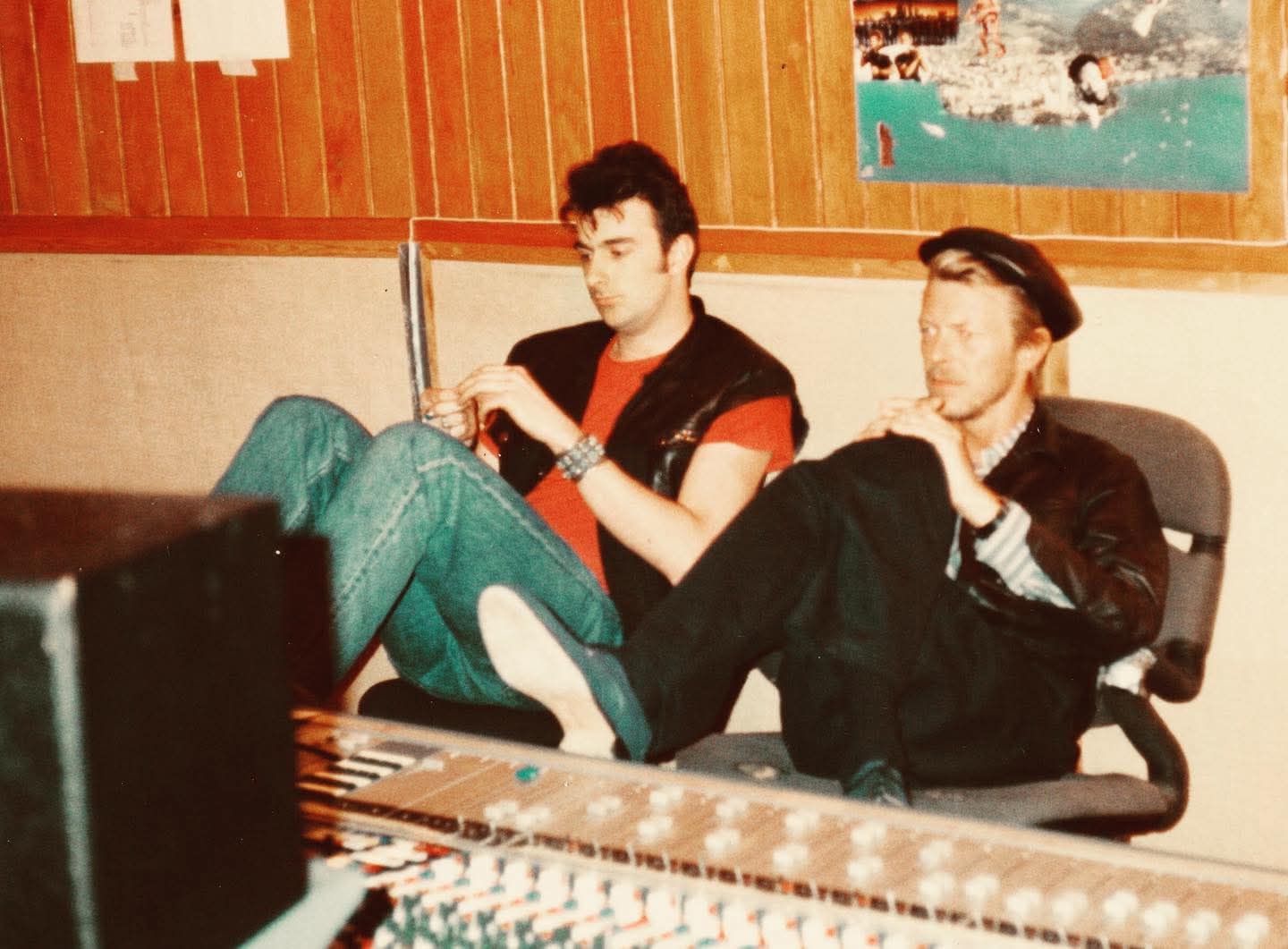
Tim Palmer with David Bowie (Internet Archive)
BR - You’ve worked with many different bands throughout your career. How would you compare Tin Machine’s cohesion as a unit to groups like U2, House of Love, or Pearl Jam?
TP - I wouldn’t use the word cohesion to describe Tin Machine’s dynamic. Chaotic might actually be a better fit. They weren’t a well‑oiled machine — in fact, they were a Tin Machine, but definitely not an oiled one (smiles). And that’s exactly what made them so exciting. They could play the same song three times — and this happened in concerts too — and each performance could be completely different. Hunt might suddenly decide to change a drum fill or shift the feel entirely, and the rest of the band had to make it work in real time. That spontaneity was part of the fun. They were all such strong musicians that they could pull off that kind of unpredictability. Lesser players would have fallen apart in those situations. And David’s singing was just extraordinary. There’s one example I always share, and I’ll share it with you too. He was recording vocals for Amlapura on the second album. He went out, sang the take, and I was blown away. He came back in and asked what I thought, and I told him it was fabulous. He listened, nodded, and said, “I’d like to do it again.” I asked him what he wanted to improve, because to me it already sounded perfect. And he said, “I want the song to sound a little more melancholic, a little sadder.” So I asked how he planned to do that. He replied, “I’m going to sing it just slightly flatter.” And he did — just barely on the edge of being flat — and it immediately gave the vocal a darker, more emotional tone. I was completely blown away. I’ve never seen anyone do that since.
BR - For many long‑time admirers of David Bowie’s career, the first Tin Machine album felt almost like musical therapy for him, while Tin Machine II seemed more like a period of sonic convalescence. Throughout your experience with the band — and given David’s insistence that Tin Machine was a democratic unit — did you ever have the chance to observe his body language or interactions with Reeves, Tony, and Hunt between the first album and the second?
TP - Not really, because I only came into the second album after the backing tracks were already recorded. My role began when I took the multi-tracks with Reeves, and we worked at Eel Pie Island — Pete Townshend’s studio — and later at Ridge Farm. Funny enough, about a year after that I ended up mixing Pearl Jam’s Ten at Ridge Farm as well. For Tin Machine II, we were mainly doing overdubs and that album is far more produced and polished than the first one. The debut was all about capturing the core performance, sketching out the whole song live, with very minimal overdubs. Maybe some backing vocals, because Tony has that very distinctive mid‑range voice that cuts through everything. Reeves might add a solo or an extra part, but overall, it was very sparse. The second album, though, was much more layered and thought‑out. Reeves had room to experiment with his guitar textures. I played some percussion; there were more keyboards... it was a more expansive production. People have different opinions about the two records, but personally, I think Tin Machine II is fantastic. I actually prefer it to the first one, though plenty of people still favour the debut. I think the first album was more cathartic for David, because it represented a complete reset. He was in uncharted waters again. I realise I haven’t mentioned the mix stage of the first album. We mixed it in New York, which for me — at twenty‑six — was mind‑blowing. Mixing at Right Track Studios while people like Yoko Ono, Brian Eno, and Iggy Pop were dropping by… it was incredible. There’s one moment from that mix I always remember. We had a rough mix of “I Can’t Read,” and, as you can hear on the record, it’s very raw and in‑your‑face. David listened and said, “I don’t think you should mix it, let’s just use the rough version.” I told him I thought I could improve a few things, and he said, “I’m not sure I want it improved. Tell you what: I’ll give you an hour. Whatever you have after an hour is what we’ll go with.” To me, that was a challenge. I said, “Alright — start the clock.” It wasn’t too difficult, but I used that hour to fix the things I felt needed attention, push the dynamics in certain places, maybe add a few subtle vocal effects to play against the dryness. And that was the spirit of that whole album — spontaneous, energetic, and very much in the moment.
BR - There are undeniably great moments across both Tin Machine and Tin Machine II. Some fans even feel that if Bowie had released a solo album using the strongest material from both records, it might have been received as an excellent Bowie album. Still, the first Tin Machine record took many listeners completely by surprise, the songs and the sound were not what people expected from a classic Bowie release. Yet that experience with Tin Machine seemed to be exactly what he needed at that point in his life.
TP - To be honest, I don’t think the first Tin Machine album was as far removed from albums like Lodger or Scary Monsters, as people sometimes suggest. Those records had that same kind of energy. And I genuinely believe that if the first Tin Machine album had been released as a David Bowie solo record, it would have received a lot more love. No question about that. The label (EMI America) were obviously hoping for a Let’s Dance II. Instead, they got World War III (smiles). David loved that. He absolutely enjoyed the fact that he was delivering something they weren’t expecting. I think it was his last record for EMI, so there were a certain freedom and mischief in that for him. There’s one moment from the Right Track sessions that really sums it up. Back then, it was standard for all the big label executives to come down at the end of the album to hear the finished record. They had no idea what they were walking into. David said, “Shall we get some bigger speakers so we can play the record for them in the room?” So, I brought in these huge monitors and set everything up. The label heads arrived — some with their wives, some with extra guests — and we blasted the album at full force. The look on their faces was priceless. They had no idea what had just hit them. It certainly wasn’t Let’s Dance II (laughs). It was so much fun. If there’s one lesson that stayed with me from working with David and Tin Machine, especially at the young age I was, it’s the value of not overdoing things. Not over‑polishing. Leaving the imperfections, the rough edges, the little human moments — that’s where the magic is. Those aspects are often overlooked, but they’re incredibly important. Watching those guys work taught me that sometimes the thing you think is “wrong”, ends up being your favourite part of the song. And the way David led those sessions was extraordinary. He never pushed people to play something for his sake, he pushed them to bring out the best in themselves. That’s why his records sound so different from one another. He created an atmosphere that encouraged reinvention. He had his core collaborators — Carlos Alomar, Tony Visconti — but he also constantly brought in new people. That mix of familiar and fresh was a huge part of why the music kept evolving so dramatically throughout his career.
BR - We know there’s a significant amount of unreleased material from the first Tin Machine album, though Bowie’s estate doesn’t seem keen on releasing it for now. You’ve mentioned that you’re occasionally in touch with Reeves Gabrels, partly through your work with the Recording Academy (Palmer has played an active role in the Recording Academy serving as a Texas Chapter board member since 2012 and completing two terms as a National Trustee). Has Reeves ever discussed the possibility of releasing a complete Tin Machine box set one day, assuming Bowie’s estate eventually gives the green light?
TP - No, Reeves hasn’t mentioned anything directly, but he would absolutely be interested and so would the rest of the band. They’re proud of those records, and they’d love to see a proper box set happen, I'm sure. The main issue, as far as I understand it, is the ownership of Tin Machine II. For reasons I’m not entirely sure about, when the deal for the second album was made, the rights to those recordings became very unclear. So the people who own the first album — and some of the live material — wouldn’t necessarily be able to include much from Tin Machine II. And without that, any box set would feel incomplete. Until someone invests the time and effort to sort out the rights to the second album, the idea just isn’t workable. That’s really the sticking point. I get asked all the time, “Are you going to work on a Tin Machine box set soon?” because I’ve got decent rough mixes of three or four unreleased songs. I honestly don’t know how they ended up online — they’re out there somewhere, but it certainly wasn’t me doing that. I still have my original cassette, and I transferred it to DAT, so I have proper digital copies of those mixes. They’re absolutely usable. I even have a multitrack as well. I’d love to put a box set together. If the estate were interested, I’d happily go out there and assemble everything. It’s a shame it hasn’t happened yet, because the material is strong and the fans would really appreciate it.
BR - Let’s talk about Tin Machine II, now, Tim. If we’re not mistaken, you were involved in co‑producing and mixing the album, but at a slightly later stage compared to the first Tin Machine record. At what point exactly did you get involved again with the band on their second album?
TP - What happened was that the band were on tour and had taken some time off in Sydney, I think. The band worked at a place called Studios 301, and they asked if I would fly out and work with them. I was a bit caught off guard by the offer, because at the time I was doing quite well work‑wise. I was very busy and I just couldn’t make it happen. I must confess it was a little embarrassing, because I remember there was a small piece in the gossip section of Melody Maker saying, “Tim Palmer has turned down working with David Bowie!” Which really wasn’t the case. I told David, “Look, I’d love to get involved if it’s possible at a later stage.” And David said, “Well, we’ve only got the tracks down, we still have to finish everything off.” At that point, he was right in the middle of his Greatest Hits tour, if I’m not mistaken, so I didn’t see too much of him. He’d come in whenever he could grab a few moments off the Tour, we’d do some bits and pieces together, and then he’d run straight back out again. I basically worked mostly with Reeves, on that album. We finished the songs up — a lot of the vocals were already done — and we’d mix them and send them to David to get his input. In essence, it was a very different experience from working on the first Tin Machine record. It certainly cemented my friendship with Reeves, because I got to spend a lot of time with him and watch him play. At that point he was experimenting with all sorts of things — vibrators on the guitar, all kinds of crazy stuff. We were able to add acoustic guitar on songs like “Amlapura,” plus percussion, piano, all sorts of textures to the record. And personally, I think it’s a great album. I love it.
BR - In that respect and in comparison to the first album, did you find easier working mostly with Reeves in creating so many different musical layers, rather than having the whole band in the studio?
TP - It was certainly more of what I was used to do. A lot of the records I made, as you know, like with The Mission, House Of Love and things like that, we were using a lot of layers in the production of the records, in the 90s and 80s, so it was a lot more familiar to me, to be in that territory, to be in control and being able to think about something and try something else, or suggesting things like "Should we try to put a harmony to that part" or "OK let's do this and that" and experiment. Capturing a live band, it was uncharted territory for me, because I hadn't done a lot of that, not to the extreme of Tin Machine, that's for sure. Although it was very exciting and there was definitely an element of danger, it was quite scary as well for me too, 'cause if you screwed it up, on the tape that they liked, there was no going back. The only thing that was interesting about the first album, because it was so live, you sort of think of it as an analogue recording, but it was actually started by Dave Richards. They had started recording some music for La La La Human Steps, a Canadian contemporary group. Dave Richards had recorded some things with Reeves and David and they used a Sony digital tape machine. As a consequence, the whole of the first album was recorded on digital tape, and it was very challenging. We had a lot of problems in Nassau, with dropouts and power supplies and things like that.. But the second album, actually, was recorded analogue and it was 24 track and again, that was way more in my comfort zone for that time. It was completely new but, you know, I remember David's very famous quote, where he says, "You should always be pushing yourself and if you walk into the water, when you start to get to the point where you're losing control, that's about right and that's where you should be to create something special". That was very much what I was doing, by trying to capture a Tin Machine record, I was, yeah, living on the edge.
BR - Tim, is it true that some of the songs included on Tin Machine II were actually recorded during the sessions for the first Tin Machine album?
TP - Absolutely. Baby Universal was new, and One Shot was new — that one was recorded with Hugh Padgham. But If There Is Something came from the first album sessions, You Can’t Talk was from the first album, and Shopping for Girls and Goodbye Mr. Ed were also from those early sessions.
BR - It sounds like there were quite a few leftovers from the first album that ended up on Tin Machine II — not to mention the material you still have in your personal archive. With that in mind, did you ever feel that maybe, at that point, David was thinking, “I just want to get this album out, and then I’m finished with the band”?
TP - I’ve wondered about that, yes. The idea of the band being a complete democracy was, I think, a bit overstated. On the first album (and I was there to witness it) they all contributed, absolutely. But once David Bowie sings a vocal on something, it inevitably becomes his work. His presence transforms it. The first album was pushing people into territory they weren’t expecting. Remember, most listeners hadn’t yet discovered the Grunge scene, or the Pixies, or Sonic Youth. David was already inspired by all of that, and Tin Machine actually pre‑dated grunge by about a year. It was uncomfortable for some people, especially fans who came from Let’s Dance and that more polished Bowie sound. As I’ve said before, if the first Tin Machine album had been released as a David Bowie solo record and you, as a fan, were coming from Lodger or Scary Monsters, I think Tin Machine II would have been held in much higher regard. But that wasn’t to be...I remember the exact moment David said, “I’ve got an idea, I think we’ll call this a band name”. They talked it through and eventually decided, “Let’s call it Tin Machine!” And I remember thinking, “No… no, please…” But what could I say? I’d spent all that time working on what I thought was a David Bowie album, and suddenly I had to accept, “No, you didn’t work on a Bowie album, you worked on a Tin Machine album”. Of course, I was still very proud of it, don’t get me wrong. But yes, it would have been nice if it had been David’s own (smiles). A song like Baby Universal, to me, is just a classic David Bowie track. It could have sat comfortably on several of his albums, and I still think it’s a great single. But the way they worked on Tin Machine II was completely different from the first Tin Machine record. Take the intro of Baby Universal — that “Uni Baby, Uni Baby, Baby talked…” section. All those voices had to be on separate tracks, each one panned differently, EQ’d differently. It was a very constructed, very deliberate production approach. Amlapura, Goodbye Mr. Ed, and You Belong in Rock ’N’ Roll are some of my favourite tracks from that album. And You Belong in Rock ’N’ Roll especially, I love the uncomfortable feeling of that song. There’s this very discordant loop running through it, and the way the production unfolds… I don’t know, there’s something really magical about it, to me. The whole approach on Tin Machine II was a different beast from the band’s first album. It was far more detailed, far more built‑up, whereas the first record was all about capturing the raw performance and keeping things minimal. But I still love both albums very much.
BR - For our website, the choice of releasing One Shot as the third single from Tin Machine II was a little debatable, especially since there were stronger songs on the album, in our opinion. What’s your view on that, Tim?
TP - I think Phil Carson, who was running the label at the time — Victory Music — simply wanted a radio hit. One Shot is a bit more traditional in its composition. The melody is easier for a lot of people to latch onto, and it felt like the obvious “radio‑friendly” choice. The thinking seemed to be, “Let’s get Hugh Padgham to produce and mix it,” because Hugh had huge success with The Police, Phil Collins, Genesis, all those major acts. Hugh is amazing, and he has an incredible reputation, but his productions were still leaning toward that very polished, very distinctive ’80s sound. I think Hunt and Tony, and probably Reeves as well, felt they were being pushed into making something that didn’t really reflect what they wanted to do as a band. They pushed back a bit, and I don’t think it was particularly easy for Hugh to cut that track under those circumstances. The funny thing is, by the time they re‑recorded One Shot, I was out in L.A. making another album and I happened to be working in the studio next door. So, I’d wander over, sit on the couch with the lads, hang out, and watch Hugh trying to wrangle everything (laughs). It was quite something to witness from the sidelines.
BR - Tim, is it true that you still have David’s 1990 Ivor Novello Award for Outstanding Contribution to British Music at home with you?
TP - Yes, I do. David was out on his World Tour, and one day he called me and said, “I’ve been awarded the Outstanding Contribution To British Music at the Ivor Novellos', and I’d be really grateful if you’d collect it for me.” I told him it would be a tremendous honour. So I went, and it was pretty nerve‑wracking, I hadn’t realised how big an event it was. They had huge screens, it was broadcast on Capital Radio, and I had to give a little speech about how happy I was to see the award go to someone like David, someone willing to take chances, and so on. Afterwards, the next time I spoke to him, I said, “Look, I’ve got your award here,” and he just said, “Yeah, it’s fine.” Then again, the next time I saw him, I reminded him again, and he basically said, “Look, I don’t want it. Honestly, that’s not my thing.” He really didn’t care for awards. That just wasn’t David. He never felt defined by trophies or accolades, he didn’t care about winning a Grammy or any of that. He made art because he had to make art, not because he wanted to compete. In the end, he let me keep the award. And the last time I saw Iman, I was at a party in Los Angeles, I think it might have been the Vanity Fair party, and I was working with U2 at the time — I went up to her and we chatted. She was incredibly kind. I said, “Please remind David that if he doesn’t want this Ivor Novello, I’m very happy to keep it, but if he does want it, I still have it.” He never reached out. So, it’s mine now! (smiles). And honestly, it’s probably my most valuable piece of rock ’n’ roll memorabilia. There’s another funny story, which you may have seen it mentioned somewhere before, from the period between finishing the sessions in Montreux and starting up again in Nassau. Out of the blue, David called me. And you have to understand that, at that time, I was wearing a lot of clothes from a shop on King’s Road in London called Johnson’s The Modern Outfitter. It was the rock ’n’ roll store in London. Madness, The Libertines, everyone shopped there. George Michael had that famous jacket from that shop in the Faith video, which recently sold for something like £50,000 (the final figure was £176.400). They had incredible stuff: beautiful jackets, amazing designs. And I was always in Johnson’s gear, back then. There’s even a photo of me and David, I think it’s online too, somewhere, where I’m wearing my “rock clothes” from Johnson’s. Anyway, one day David called me on one of his rare days off and said, “Hey, Mr. P, do you want to go out and show me where you get these jackets? I need to buy a jacket for Melissa (Hurley, actress, dancer and Bowie's girlfriend in the early 90's) and my son.” The idea that David Bowie was asking me to take him shopping was just unbelievable. So, he picked me up in a car, and off we went to Kensington Market, where I took him into Johnson’s La Rocka store. Even telling the story now, it still feels unreal. It doesn’t seem believable — but it happened.
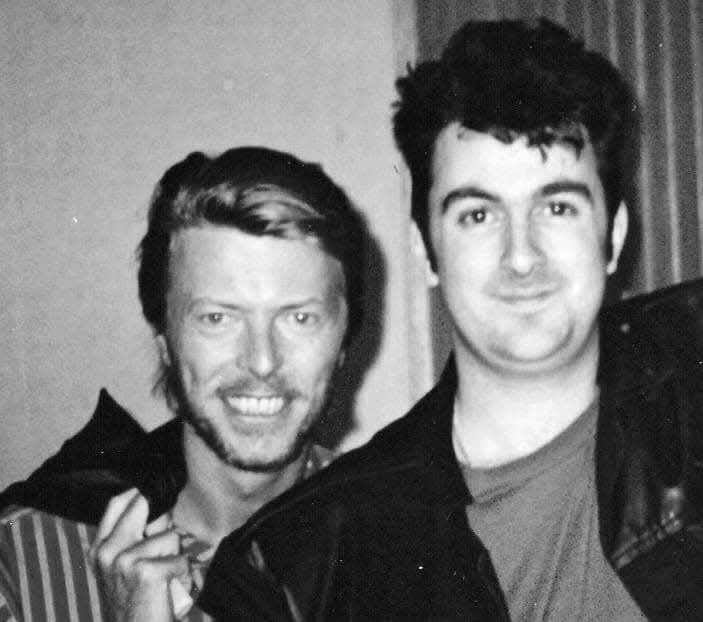
Tim Palmer with David Bowie (Internet Archive)
BR - Do you remember the last time you spoke to David, or the last time you saw him in public?
TP - I actually don’t remember exactly. It was probably just a short time after we finished the second album. It’s funny, with a lot of artists, it’s the same pattern. It was like that with Ozzy (Osbourne) as well. You become very close when you’re working together, because you’re in that intense working bubble for months. But then they move on, they’re in their own world again, surrounded by a new set of tours, people, new collaborators, new friends, and sometimes you just lose touch. Some other artists I’ve stayed very close to, like Robert Plant, for example. After all these years, whenever he comes into Austin, he’ll invite me to his show, we meet up, and he’s always lovely. But other artists drift off into the ether. And sadly, with David — being the superstar he was — that’s what happened. It just faded away. It’s a little bittersweet to say, but it’s the truth. I’m incredibly grateful for the time I had with him. Those memories mean a lot.
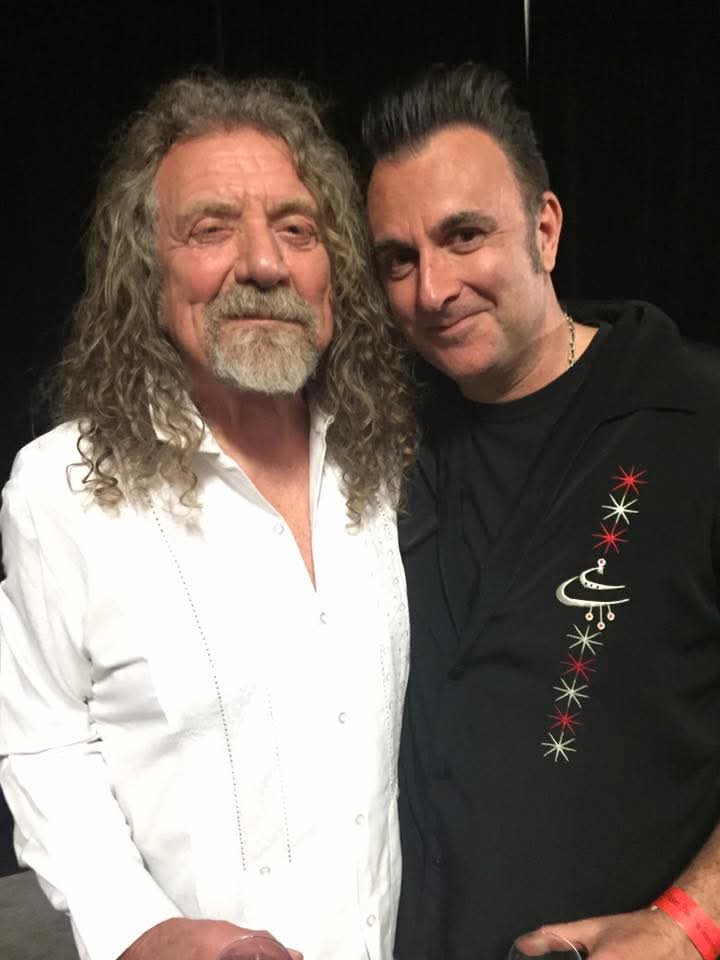
Tim Palmer with Robert Plant (Internet Archive)
BR - Tim, let’s shift the conversation to your own remarkable career as a producer, engineer, and musician. Throughout this interview we’ve touched on many of the artists you’ve worked with, but there’s a particular band and a particular record we’d like to focus on: Tears for Fears’ 2004 album Everybody Loves a Happy Ending. It’s a record where the band stepped away from their trademark sound, and you mixed it at Larrabee North Studio in California. We know you’ve had a long‑standing collaboration with Roland Orzabal going back to the ’90s — and still going strong — and Roland has always spoken very highly of your work together. Given that Everybody Loves a Happy Ending marked the reunion of Roland and Curt Smith after many years apart, how did you find working with both of them on a record that, in our opinion, never received the appreciation it deserved from the press and the fans?
TP - It’s interesting you bring up that album, because you’re right — sadly, most people don’t even remember it. Like yourself, I love that record too. I think it’s a really great one. And it’s great for many reasons: the song-writing, of course, but also because it was the first time Roland and Curt had come back together after so long. When I first got the call to work with Tears for Fears, it wasn’t made clear to me that Curt was no longer in the band. So, I started working with Roland, and he explained the situation. I became very close to Roland, so for a while I was naturally in “Roland’s camp,” as it were. When we made Everybody Loves a Happy Ending, it was important to me that Curt understood that whatever had gone on before between them wasn’t relevant now. They were back together, and I was genuinely happy about that. In so many great bands, a member brings something essential that often gets overlooked. A perfect example is U2: people might say Adam Clayton’s bass playing is very straight or simple — but that’s exactly what U2 needs. It gives The Edge the space to play the parts he does. If they’d brought in someone playing in a flashier way, it would have ruined everything. I felt the same way about Pearl Jam. Dave Krusen’s feel on Ten — which I mixed — was incredibly special. It’s not about technical ability; it’s about what you bring to the table. And with Tears for Fears, Curt brought perspective. He could say, “No, that’s too much,” or offer a melody that seemed simple, but ended up being the most memorable part of the song. Roland could write all the cool lyrics and intricate parts of Sowing the Seeds of Love, but Curt singing “Sowing the seeds of love, the seeds of love…” — that melody is what pushed the song over the edge. Together, they have something truly special. Roland was also wonderful to me personally. When I first worked with him, he gave me confidence as a musician. I’d always kept that side of myself quiet — I felt embarrassed playing on people’s songs, because I thought the “real musicians” were everyone else. I’d play small ideas in the morning before Roland arrived, and if he heard them, he’d say, “No, I want to hear that.” He’d make me turn them up and encouraged me to contribute. No one had ever done that for me before. We worked together with Roland on Elemental — just Roland, Alan Griffiths (who sadly passed away), my engineer Mark O’Donoughue, and me. Four of us in Roland’s studio in Bath. Then came Raoul and the Kings of Spain, with, funnily enough, given the context of this interview, a Bowie connection: Gail Ann Dorsey on bass. We also had Brian McLeod on drums, Jeff Trott on guitar — all people I’d worked with before. Roland essentially formed a new Tears for Fears for that record. After that came the B‑sides collection Saturnine Martial & Lunatic, and gradually Roland and Curt reconnected. I was very fortunate that Roland persuaded Curt to let me mix Everybody Loves a Happy Ending. Curt was incredibly gracious, and we got on very well. I even mixed his solo album Halfway, Pleased, which has just recently come onto streaming services. That meant a lot to me — after everything that had happened, Curt embraced what I brought to the table. We mixed Everybody Loves a Happy Ending on a brand‑new SSL K‑series console at Larrabee Studios — a beautiful desk. It takes time to get things right with Roland and Curt because they both have strong opinions, but I really loved working on that record.
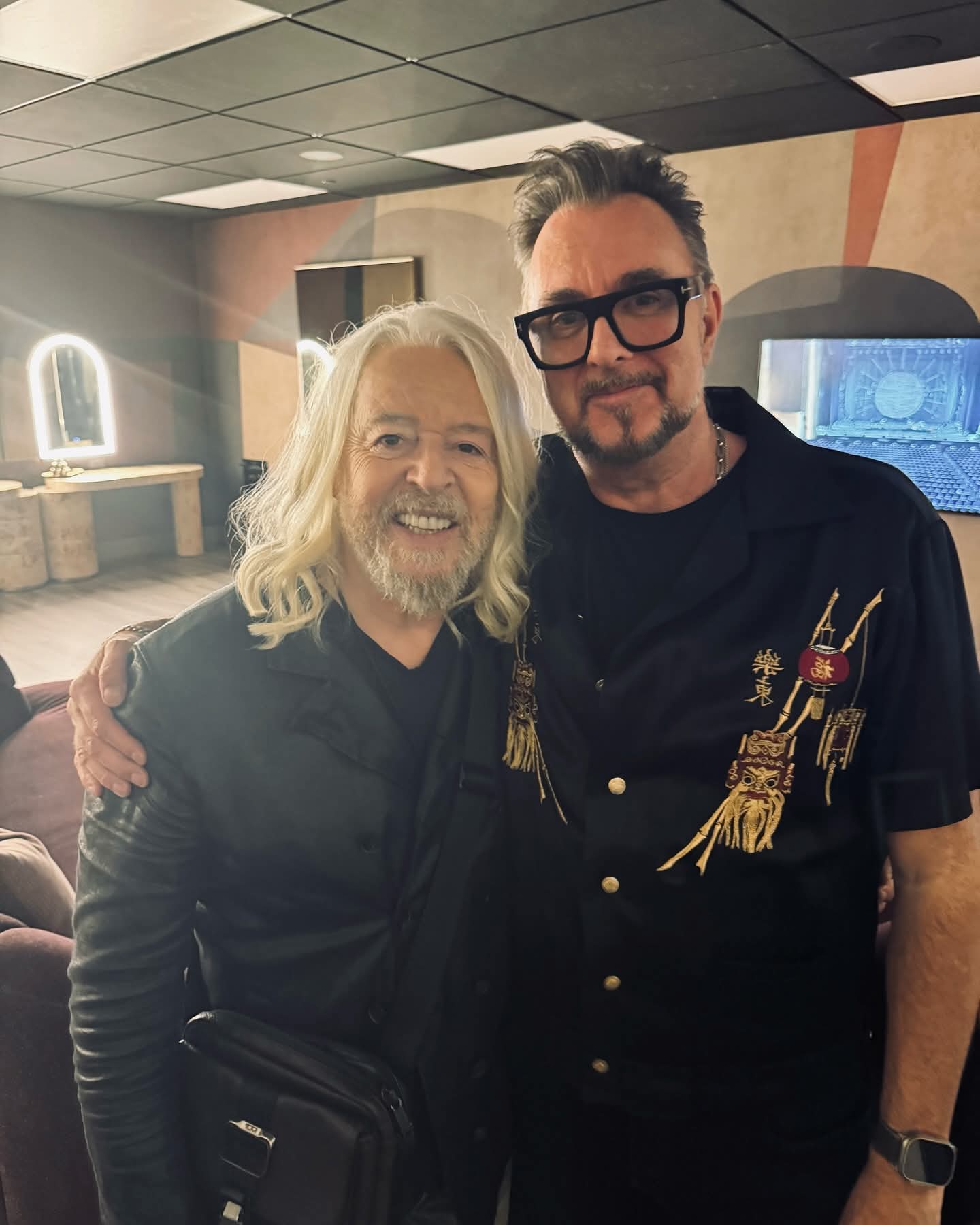
Tim Palmer and Roland Orzabal (Internet Archive)
BR - Roland Orzabal has said, in recent interviews, that Everybody Loves a Happy Ending was the album where he and Curt Smith had fewer disagreements than on any other Tears For Fears record. It’s undeniably a very harmonious album, with a nod to the Beatles trademark sound, strong song-writing, and, above all, a project that allowed them to work together again toward a common goal.
TP - I’d agree with that. They worked with Charlton Pettus, who in a way, came from Curt’s camp, because Charlton had worked with Curt before he worked with Roland. Then I came in to do the mixing. Charlton still works and plays with them to this day; he’s a wonderful guy, and he makes people feel really comfortable. He was also (and still is) a great bridge between Roland and Curt. I think Charlton was a very important part of the puzzle for that album. Working with Tears for Fears has always been a joy for me. I feel genuinely blessed to have worked on all those records; I really love them. Roland has a new book coming out, and I’m excited to read it and see what he says. I’ve heard he’s always had nice things to say about me, which I’m grateful for. It’s funny when I look at my career; a lot of producers make a record with an artist or a band — sometimes their biggest record — but the band doesn’t actually have a good experience making it. So even though the producer delivered the hit, the artist never goes back to them. Making a record should be a fun process. We’re so incredibly lucky to do this for a living. Yes, there are problems and things that need fixing, but there’s always more than one way to solve them. As a producer, your job is to help the artist reach their vision, not yours. For example, if you feel the chorus needs something in the high register to make it more resonant, you might have an idea. But if you can encourage the artist to come up with the solution and you get the result you need, it doesn’t matter how you got there. If they don’t come up with anything, of course you offer your idea. I play on a lot of records and add little bits and pieces, but ultimately, you want the artist to do that part, because that’s what makes the project unique and special. My approach is always to help someone make the record they want — and make sure it’s a good one at the same time. I know what I’m trying to achieve, and I believe strongly in the storytelling aspect of mixing. When I’m working on a mix, I’m always thinking: What am I trying to convey in this section? What’s the most important element? What’s missing? What needs to come forward? What’s supportive rather than essential? If you think of a song like a story, the verse leads to the chorus the way a chapter leads to the big moment in a book. It’s not rocket science — it’s just finding a way to make the record successful. And if you rely too heavily on specific pieces of gear — “it has to be a valve this,” or “a ’67 Telecaster,” or whatever, then you miss the point. Just use something that works. Make it work. Make it emotive. Make it mean something. It’s not about perfection. It’s about the quality of the final outcome.
BR - Tim, you’ve been one of the most appreciated musical contributors to The Recording Academy for several years now. But some may not know that you’re also a connoisseur of Jazz and have worked on several contemporary Jazz albums with major artists like Lang Lang and Billy Childs, among others. Who were your favourite Jazz heroes, growing up, the ones who sparked your love for the genre?
TP - Well, if I’m honest, I really don’t have much knowledge of Jazz at all. I’m aware of the classics, of course, but I wouldn’t describe myself as a great lover of Jazz. I actually grew up more as a punk rocker. I loved The Clash, The Jam, the Sex Pistols and, from there, Siouxsie and the Banshees, Magazine, and all the alternative music that followed. When I was young, my dad listened to a lot of Dave Brubeck, so I was aware of Jazz through him. But I’ve always liked all types of music, and to me “genres” are really just different forms of presentation. My real introduction to working in Jazz came through Larry Klein, a very famous producer who’s won Producer Of The Year twice at the Grammys. He was married to Joni Mitchell, he’s a legendary bass player, and he’s played with so many great Jazz artists. He even played bass on Tracy Chapman’s Fast Car and on Peter Gabriel’s So. He’s an iconic producer. In 2013, Larry’s mixing engineer Mike Shipley, one of my heroes, sadly passed away. Larry had the same manager as me, and he was looking for someone to help him mix the record he was working on. He reached out, we talked and decided to try working together. Larry opened up a whole area of music I had no expertise in whatsoever. But, as we discussed earlier, if you think about making things successful and apply that to Jazz, it’s not hard. Maybe because I came from such a different musical background, I could offer something he wouldn’t have thought of. What struck me most, about mixing those Jazz records, was the incredible musicianship involved. It was so good that I found myself working the faders far more and using much less aggressive automation. Jazz isn’t about overly compressing or EQ’ing things — it’s a much more organic process. I learned a lot from that. Sometimes Larry would send notes and I’d think, “Whoa, I’ve got a way to go here,” but those records taught me so much. I have very fond memories of working with Melody Gardot and Billy Childs. Some of my favourite‑sounding records are the ones we made with Kandace Springs, I absolutely love those albums. With Larry, we also did tributes to Charlie Parker and Jacques Brel, and people like Carla Bruni and Marianne Faithfull came in to sing on those records, among others. Through that work, I was introduced to all these wonderful artists and albums. If it wasn’t for Larry, I wouldn’t have had that opportunity. I’m eternally grateful to him for opening that door.
BR - Tim, for someone who has worked — and still works — with the elite of the music industry, asking “What’s next?” might feel like asking for the moon. But even after such an outstanding career, is there still an unfulfilled wish you’d love to achieve in your field?
TP - I think my unfulfilled wish — and I hope I’ll achieve it — is simply to keep going, but to do less. I’m 63 this year, and I’ll be honest: it’s a bit of an ageist industry. These days, people aren’t always interested in working with someone “vintage,” which I suppose is what I am now. So I think of my career the way I think of the master fader at the end of a song — a slow fade. A lot of people retire, get the gold watch, and the next day they’re sitting in front of the TV wondering, “What am I going to do with my life?” My wish is to avoid that moment. I want to fade out gently, like the perfect ending to an album. I’m doing less work now, but I still love it. I’ve just built a brand‑new studio with my engineer, and we’re mixing projects. As long as I can keep being creative, that’s what I want — just at a slower pace. I want to spend more time with my grandchildren, travel more, and give back to my wife, who’s put up with me all these years. She deserves that. She’s been so supportive. And I’d like to see more of my kids, who probably suffered from not having their dad around as much — I know that for sure. So yes, that’s what I’d like to achieve as I head into the perfect fade.